A new landmark study by the International OCD Foundation finds that millions of Americans living with obsessive compulsive disorder (OCD) are not receiving care that could help them reclaim their lives.
Up to 10 million Americans live with OCD, yet only one in six receive a correct diagnosis. As a result, 95% of people in the U.S. with OCD do not receive the most effective treatment, despite strong evidence that specialized therapy can significantly reduce symptoms and restore daily functioning.
These findings represent the real-life struggles that individuals with OCD face daily when trying to get an accurate diagnosis and access effective treatment.
In this blog series, IOCDF Advocates bravely share their experiences to shed light on the IOCDF’s recent findings.
Erika McCoy
Erika McCoy spent nearly two decades living with OCD symptoms before being properly diagnosed. Today, she leads IOCDF’s Creative Expression Special Interest Group and uses art to express her experience with OCD.
In her piece, (nearly) 2D, McCoy explores the delay she experienced in receiving a diagnosis.
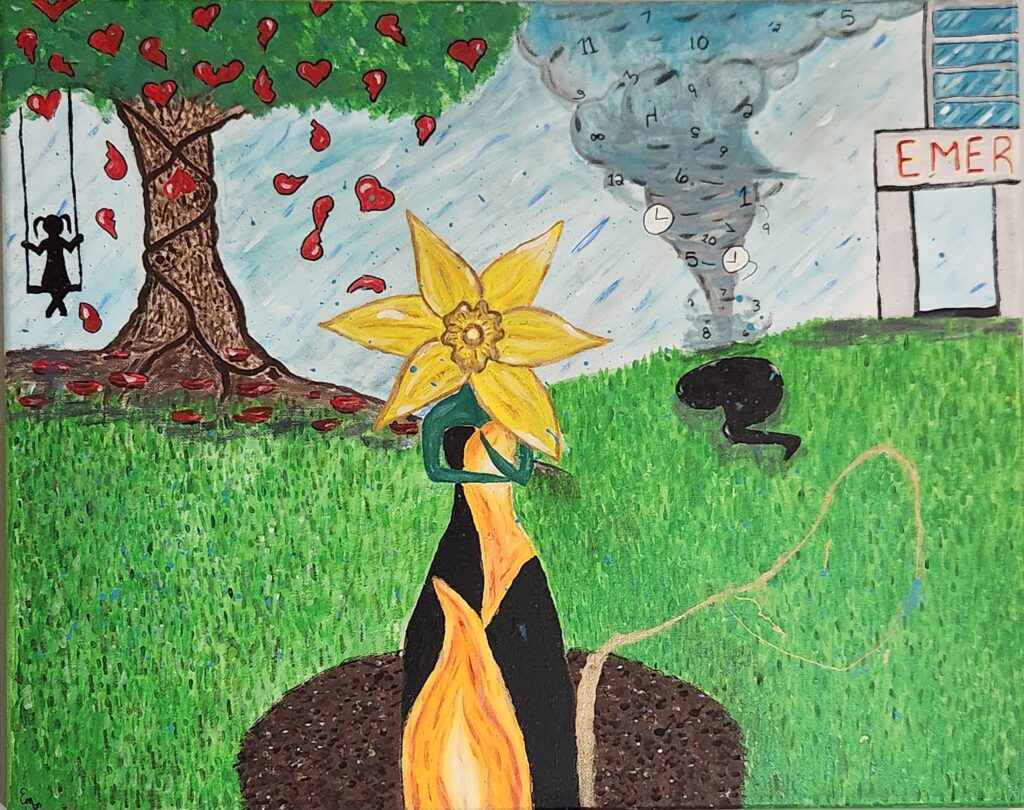
“This painting represents the time of my life from childhood to about 25, when I was truly suffering from undiagnosed OCD,” McCoy explained.
“In this painting, you see a tree. I call it the tree of broken hearts. And that symbolizes my early childhood, when I first started getting the signs and symptoms of OCD.”
“I had no hope at all,” McCoy recalls, noting that she was struggling with other diagnoses as well, which are also represented in the broken hearts at the base of the tree.
McCoy first attended a partial hospitalization program in a clinical setting around the age of 13 or 14. Despite being thoroughly evaluated and sharing openly what she’d later identify as OCD symptoms, McCoy received a generalized anxiety diagnosis, something she sees now as a missed opportunity to have received a proper diagnosis and treatment early on, possibly avoiding years of needless suffering.
“I told them all these things, and they still missed the mark on all that somehow,” McCoy recalled, stressing the importance of proper diagnosis early on.
“I had to advocate for myself so much to finally get diagnosed with OCD,” McCoy recalled.
“And it didn’t happen until everything in my world was totally falling apart and I was absolutely nonfunctional. I wasn’t able to work anymore… I was about to get fired from my job… I wasn’t able to brush my teeth…I couldn’t eat… It got to a point where I was just so severe.”
Covering the painting is teal paint splatter, McCoy explained, because “the whole time it was always OCD.”
Rising from the center of the painting is a daffodil, McCoy described as representing herself, beautiful but also potentially dangerous.
“Daffodils are actually poisonous, but I think they are beautiful,” McCoy remarked.
“Because by the time I got diagnosed with OCD, I believed I was a terrible, poisonous person. But daffodils are also beautiful,” McCoy said.
“I may feel poisonous and like a terrible person, but still, that doesn’t mean that that’s true, right? It’s just like art.”
The gold line in the painting, McCoy explained, represents the gold standard of treatment for OCD, which she finally received: exposure response prevention, ERP.
For McCoy, it’s essential to underscore the importance of making treatment more accessible, as after she finally received a diagnosis, she was unable to access treatment.
“Once I learned about ERP, every option that was available to me was out of my realm of possibility to afford, thus leaving me no other option but to do it on my own…”
IOCDF’s findings reflect McCoy’s experience, with 95% of people in the U.S. with OCD failing to receive ERP, despite strong evidence that specialized therapy can significantly reduce symptoms and restore daily functioning.
“ERP is the fuel of my awaking with the force of a May storm; the kind that lifts a wilted flower into fullness,” McCoy shared.
“It feeds my transformation, strengthens my blossom, and carries me onward to a place that feels golden and buzzing with life.”
The post America’s OCD Care Crisis: The Stories Behind the Statistics: Erika’s Story appeared first on International OCD Foundation.