
Building The Black and Living with OCD (BLOC) Project
When you ask Dr. Ogechi “Cynthia” Onyeka about her work on The Black and Living with OCD (BLOC) Project, her entire face lights up. Onyeka is an Assistant Professor in the Department of Psychiatry and Behavioral Sciences at Baylor College of Medicine in Houston and an International OCD Foundation Grant Recipient, having won the Jenike Young Investigator Award in 2024. The BLOC Project is the one which Onyeka received the IOCDF Grant for, and it is, as Onyeka admits “quite ambitious.” “I’m really excited to be a part of it and to see what we find,” Onyeka said. As Onyeka describes, the project is a mixed-method study, which examines the lived experiences of Black Americans with OCD to understand factors such as how OCD symptoms show up and what
A Call for More Diverse Participation in OCD Research (and How You Can Help)
This article originally appeared in the Winter 2024 Edition of the OCD Newsletter. By Boris Litvin, MA, Matthew Riello, and Andrew Marshall, PhD OCD and related disorders research rests on the shoulders of giants — scientists and research participants. Through collaboration and trust, they advance knowledge together, so that the 2.3% of the population who have OCD can understand it and access treatment. People volunteer (or receive benefits, like money or free therapy) to provide scientists valuable insights, so we can better understand how OCD and related disorders function, if treatments are effective, and how socioeconomic factors play a role, among other things. However, two massive issues remain: 1. There are still not enough research participants. 2. There is a gap in diversity and representation. Low Research Participation & Diversity
10 Critical Lessons to Teach Your Kids About Organizing: These Benefit You, Too!
By Kim Mazewski, CPO® | Originally posted on www.consciouslyclearedandcontained.com Edited for GO Month The subtitle here is “…even if you don’t consider yourself organized.” No judgment, this is a family affair. You can benefit from these lessons too, you can strengthen these skills, you can practice together and model. You can lead by example and gently nudge your kids toward a tidier home. You can show them how amazing it feels to center your home around memory making, rest, and play—instead of clutter, chaos, and overwhelm. Read on for concrete examples, sample scripts, tangible advice you can start today—it’s not too late, even if they’re grown and have a family of their own, teens, school age, or babies! QUALITY OVER QUANTITY — it starts with being a conscious consumer If
Bridging Borders: Advocacy Across the Globe
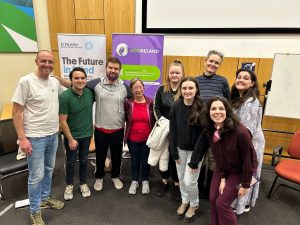
Andrew Gottworth is an IOCDF Advocate based in Berlin who leads the IOCDF International Networking and Advocacy Group (INAG), a vibrant mix of individuals from a variety of backgrounds and hailing from various countries, including Nigeria, Ireland, Kuwait, Germany, Spain, and Australia. This group is open to individuals with OCD and related disorders, family members and loved ones, and professionals interested in building connections and facilitating networking opportunities among individuals outside the US, across different countries and time zones. Advocacy at a global scale is critical to fulfilling our mission and raising public awareness! Recently Andrew embarked on an exciting journey to connect with other advocates who share our mission to break the stigma, raise awareness, and provide resources to the global community. Read about Andrew’s advocacy adventures below! The

Common Parent Questions, Answered by Young Adults with Lived Experience
Parents of children and young adults with OCD have many questions they’d like to ask their kids about OCD, and we, the members of the Young Adult Special Interest Group, certainly have a number of things we’d like to ask our parents. In this blog series, young adults with OCD answer some of the most common questions parents or loved ones have based on their own experiences! – Disclaimer: all responses are based on personal lived experience rather than clinical training. This blog series is meant to provide insight into what one’s experience with OCD might be like and is in no way intended to serve as professional advice. For professional advice, please seek a trained and licensed clinician. – Definitions SIG: Special Interest Group Exposure and Response Prevention or
Mapping the Regional Influences of OCD
By Caitlin Pinciotti, PhD “OCD latches onto what you value” is a phrase most of us have probably heard or said in OCD treatment. It is why we believe that religious scrupulosity OCD is more likely to afflict someone with strong religious principles, why perinatal OCD is more likely to afflict someone who is a devoted parent, and why harm OCD is more likely to afflict someone who would never even harm a fly. OCD themes do not come from nowhere. They develop out of a deep fear that the worst-case scenario for each individual person — committing an unforgivable sin, failing to protect a beloved baby from imminent harm, hurting a loved one intentionally — could come true. If we think of intrusive thoughts like insects annoyingly buzzing around,
OCD…and ADHD: An Advocate’s Treatment Experience
By Maya Tadross After years of progressing well through exposure and response prevention (ERP) therapy, I found myself at a standstill, unable to tackle certain symptoms attributed to OCD and anxiety. Restlessness, fidgeting, distraction, and slow processing persisted for me, despite my having achieved a major decrease in my obsessing and anxious thinking. I never expected my subsequent ADHD diagnosis to be the missing link in my OCD recovery. I recently learned that about 30% of people with OCD meet the diagnostic criteria for a comorbid ADHD diagnosis (ADDitude Magazine.) When both OCD and ADHD are present, research indicates that treating only one of them results in poorer treatment outcomes (Advokat & Scheithauer, 2013.) Further, a study by Farrell et al. (2020) found that children and adolescents with both disorders
My Acronym
On October 14th, OCD Kansas hosted one of many OCD Walks taking place across the globe. Over 60 participants came together to connect, share their stories, and make a meaningful impact, delivering a powerful message of solidarity to those on the path to recovery—you are not alone. IOCDF Advocate Krista Reed, LSCSW, served as the event’s Grand Marshal, opening the festivities with this poem. My Acronym By Krista Reed, LSCSW OCD. You are three simple letters And yet You have brought a world of emotions to me. O equals overpowered You broke into my world at age 6 The uninvited party guest with no gift Halloween year-round with only tricks O equals overloaded My young mind had so much to carry From sins, to AIDS,
Enhancing Support for Older Adults with Hoarding Disorder: Senate Aging Committee Chairman Highlights Federal Action Steps
The International OCD Foundation (IOCDF) commends Senate Aging Committee Chairman Bob Casey for his recent letters to the Department of Health and Human Services (HHS) and the Department of Housing and Urban Development (HUD), underscoring the need for expanded federal support for older adults affected by hoarding disorder. Chairman Casey’s letters follow the Consequences of Clutter report from the U.S. Senate Special Committee on Aging, which outlines recommended steps to improve resources and support for older Americans impacted by this condition. Hoarding disorder is a significant public health issue, especially for older adults, who are three times more likely than younger individuals to experience hoarding symptoms. These symptoms often increase with age, raising risks such as falls, malnutrition, social isolation, and homelessness. Chairman Casey’s recommendations focus on key areas where
Join us in sending Messages of Hope this holiday season!
The holidays can be a hard time for those who are away from home to get help with their OCD. Something as simple as a card and a message from the heart can make a huge difference. That’s why the IOCDF is asking for your help to send messages of hope to those undergoing treatment for OCD. We are partnering with Not Alone Notes to create fun and inspiring cards for the holidays! Check out their video tutorial for sending a card. Here’s how you can participate: Download & print our festive templates, purchase, or create your own Holiday card.Design and messaging are up to you but remember that you won’t know who will receive it — so please choose a secular or non-denominational card.Write your message of hope.